
Uber Pitch Deck
The Uber pitch deck is the 25-slide UberCab deck from 2008, written before the app or the first car existed. It pitched a members-only, one-click black car service for professionals in San Francisco and New York, "the NetJets of car services", and its last slide lists the next steps: buy 3 cars, build the app, demo on February 1st, raise a few million. Below is every slide in order: what it says, and what founders can still copy from it.
22 more slides
Sign up free to view the full deck here and study more real decks that raised.
- Industry
- Transportation
- Business model
- C2C
- Round
- Seed
- Year
- 2008
- Raised
- $1.3M
- Founded
- 2009
- Slides
- 25
How this deck compares
Uber closed its Seed round with a 25-slide deck. That is 13 slides longer than the median Seed deck in this library, which runs 12 slides across 134 decks that actually raised.
The round brought in $1.3M.
The Uber pitch deck, slide by slide
1. UberCab
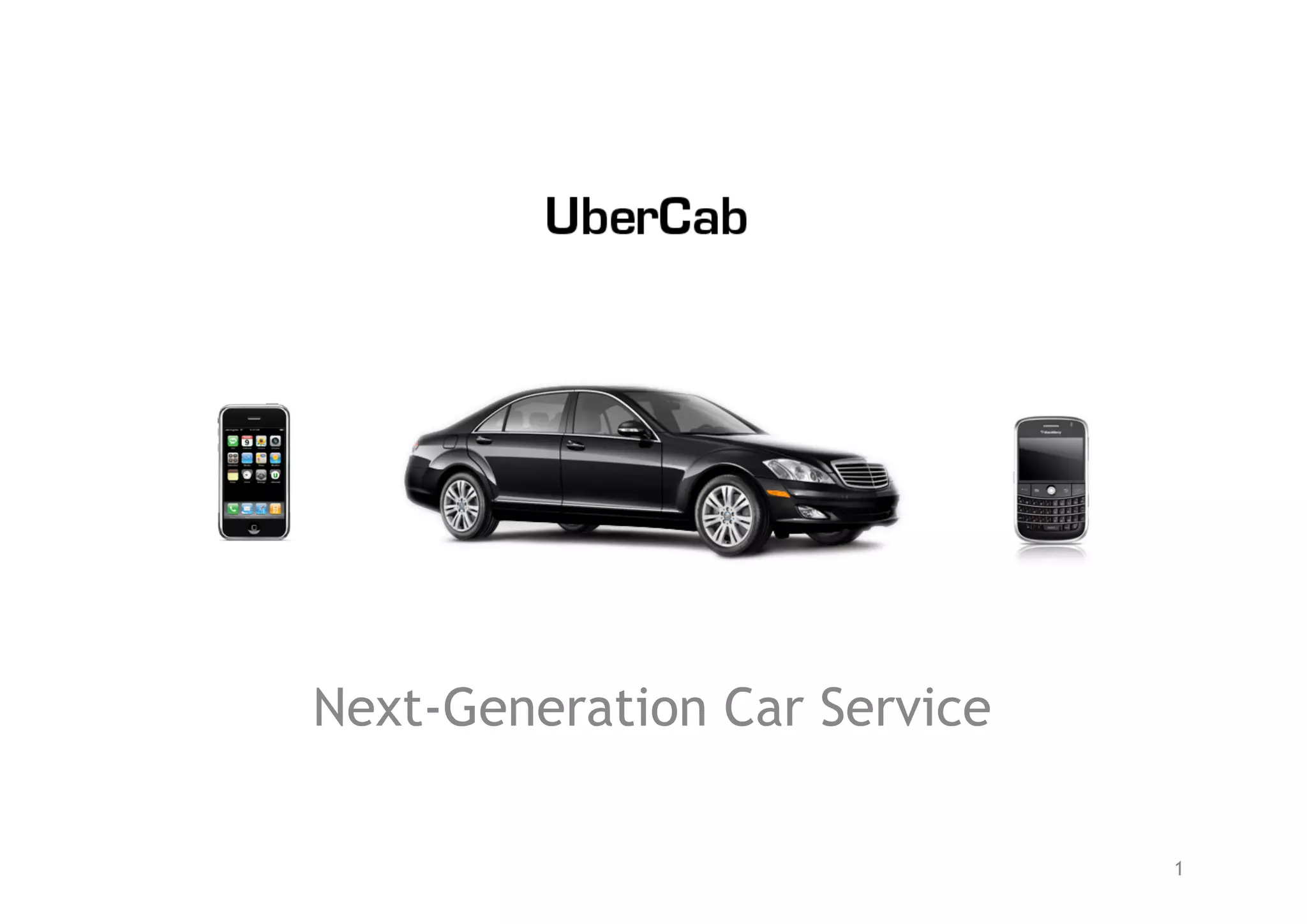
The UberCab wordmark, a black Mercedes sedan between an iPhone and a BlackBerry, and one line: "Next-Generation Car Service."
The cover names the category (car service) and the edge (phones) without a word of explanation. Note the category: a premium car service, not ridesharing.
2. Cabs in 2008
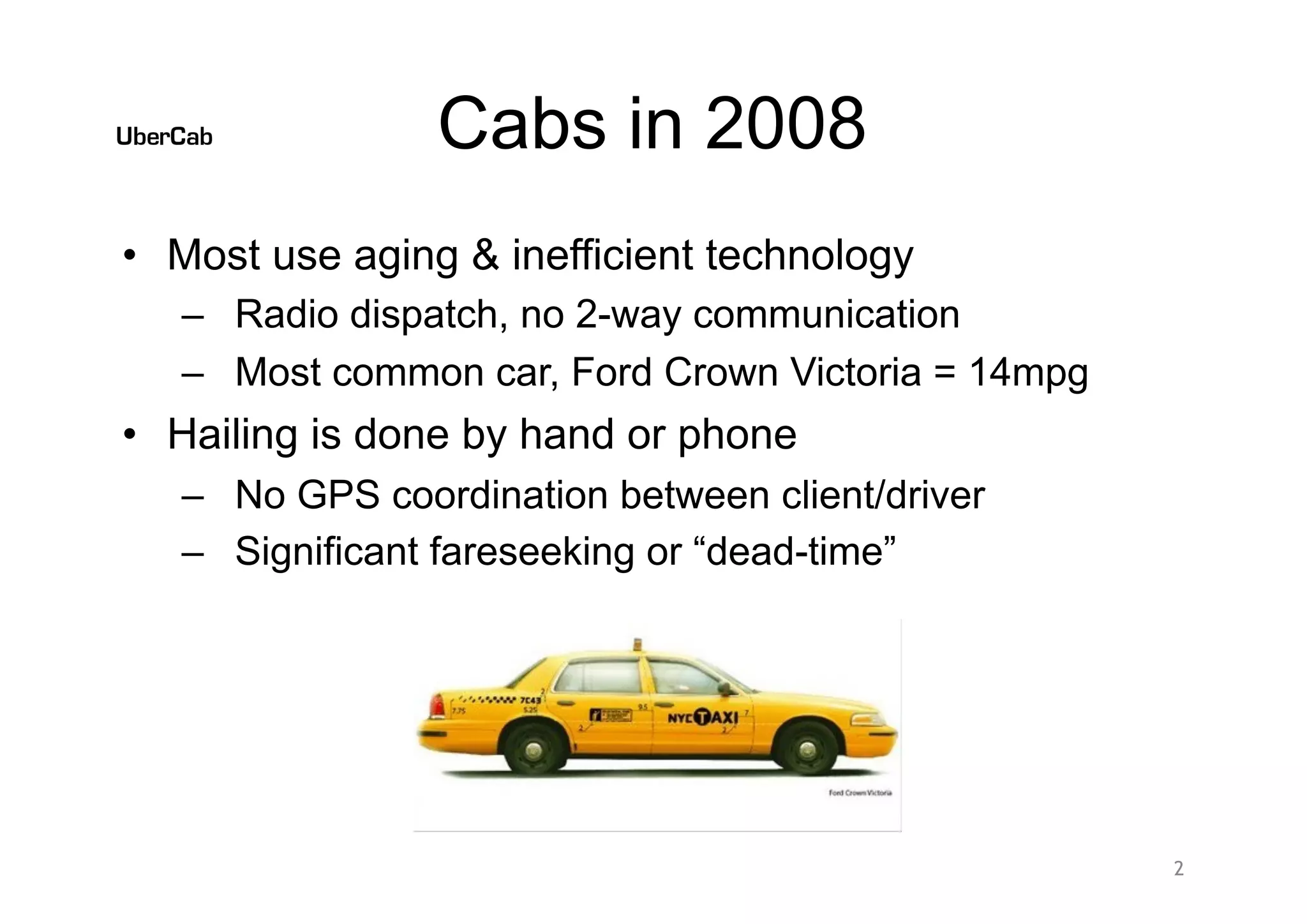
Most cabs use aging and inefficient technology: radio dispatch with no two-way communication, and the most common car, the Ford Crown Victoria, at 14 mpg. Hailing is done by hand or by phone, with no GPS coordination between client and driver and significant fare-seeking "dead time".
The problem is framed as old technology, which sets up a phone and GPS answer. Small specifics (radio dispatch, a 14 mpg Crown Victoria) make it concrete in seconds.
3. The Medallion System
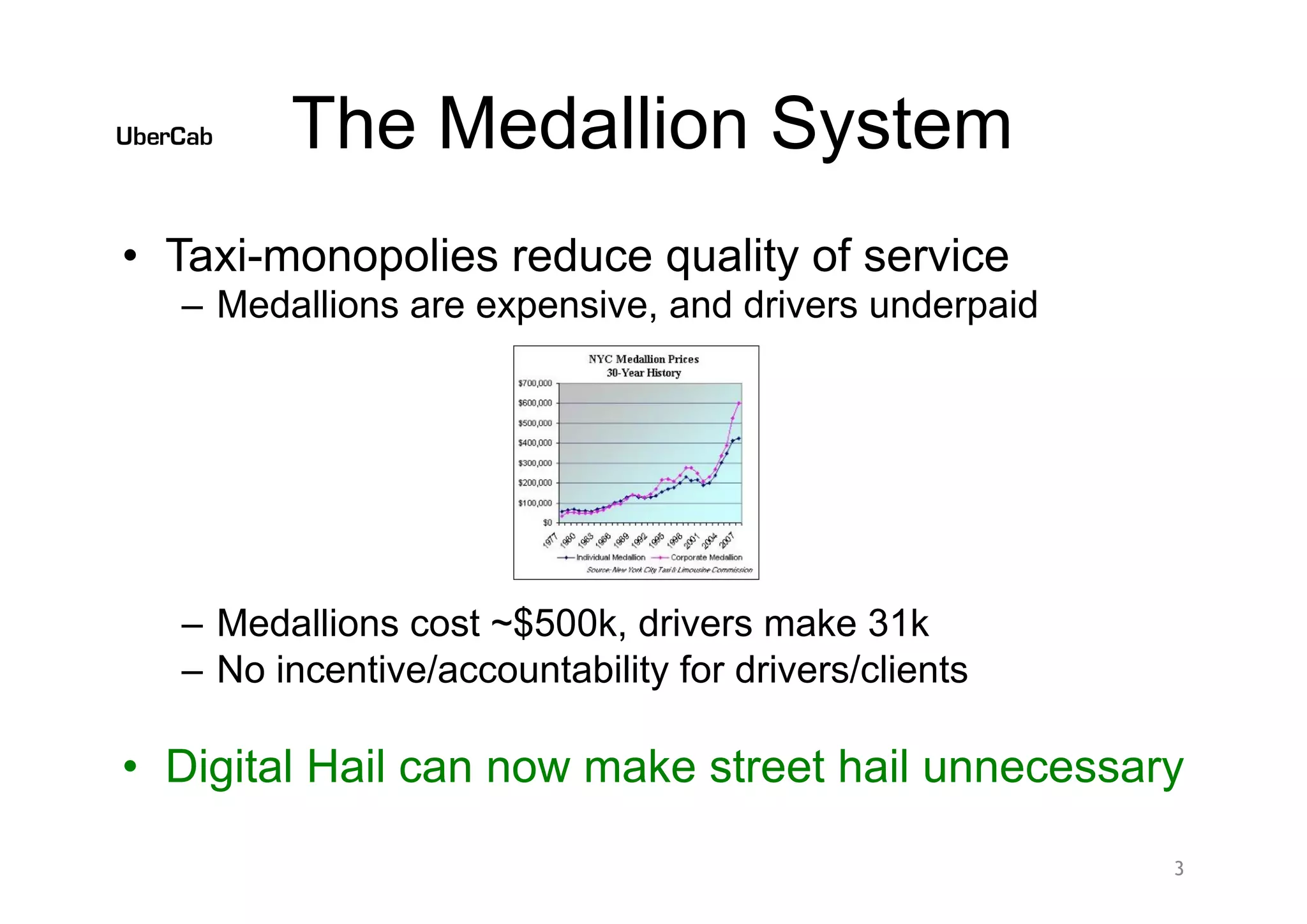
Taxi monopolies reduce quality of service: medallions are expensive and drivers are underpaid, shown on a 30-year chart of NYC medallion prices. Medallions cost about $500K, drivers make $31K, and there is no incentive or accountability for drivers or clients. The closing line, in green: "Digital Hail can now make street hail unnecessary."
This slide explains why the incumbents cannot fix the problem themselves, then states the insight in one line. It is also the "why now" of the deck.
4. UberCab Concept
A fast and efficient on-demand car service for professionals in American cities: the convenience of a cab in NYC plus the experience of a professional chauffeur, in SF and NYC. The latest web and device technology automates dispatch to reduce wait time, with optimized fleets and incented drivers. The "NetJets of car services".
One analogy carries the positioning: NetJets says premium, on demand and members only. A familiar comparison does more work than a paragraph of description.
5. 1-Click Car Service
You must be a member to use the service, for a professional and trustworthy clientele. Cars are not hailed from the street, so no medallion licenses are required, since clients are members using a digital hail. Pickup is guaranteed, unlike a yellow cab: a mobile app matches client and driver, and each sees a photo of the other.
The regulatory question is answered before an investor can ask it: no street hails, no medallions. Name the biggest risk in your model and show the path around it.
6. Key Differentiators
Members only (respectable clientele), 1-click hailing ("Pickup here in 5 mins"), fast response time (easier than calling), luxury automobiles (Mercedes sedans), great drivers (a "Rate your trip" feature), a high-tech solution (geo-aware auto-dispatch) and an optimized fleet (logistical location software).
Every differentiator is paired with the feature that delivers it. Trip ratings and automatic dispatch by location are both here in 2008.
7. Operating Principles
Luxury service on demand, a modern and fuel-efficient fleet, customer-focused and computer-coordinated, the best end-user experience possible, statistically optimized response time, a pre-paid cashless billing system, and "profitable by design".
Cashless billing is already a principle here. "Profitable by design" with no numbers behind it is the kind of line an investor will push on.
8. UberCab apps
1-click requests from geo-aware devices, and SMS from any phone ("pickup @work in 5"), shown on an iPhone, a BlackBerry and a Nokia.
The plan covers every phone of 2008, with SMS as the fallback for phones without apps. Show investors you thought about reaching all of your users, not only the newest devices.
9. UberCab.com
Book trips and see fleet status and trip history. Pre-set locations with labels and coordinates to make texting a pickup easy, with Google Maps integration: coordinates saved as "home", "bob-work", "alice-apt".
Saved places, so a pickup can be requested in one short text. A small, specific feature like this proves the team has thought through the real experience.
10. Use-Cases
Trips to and from restaurants, bars and shows; fast local transport where parking is hard; pre-scheduled airport pickup and drop-off; working while commuting with wifi in the car, including a 3-person rideshare to a South Bay campus; dropping kids at school; elderly transport.
Concrete situations let an investor picture real trips. The shared ride to a South Bay campus is the first hint of pooled rides.
11. User Benefits
Cabs do not guarantee pickup and can take 45 minutes; cabs are not as safe or clean as limos; car services need 1 to 3 hours notice; car service transfers average over $60 plus tax. "UberCab would be faster & cheaper than a limo, but nicer & safer than a taxicab."
A positioning formula worth copying: faster and cheaper than one option the investor knows, nicer and safer than the other.
12. Environmental Benefits
Better use of vehicles: in NYC 35% of time is spent looking for fares, over half in less dense cities, and "as swarm size increases, efficiency will improve". Hybrid cars at twice a cab's efficiency (Mercedes S400 BlueHybrid, Lexus GS 450h). Lower rates for ridesharing and carpooling, such as a trip to SFO or from the ballpark to the Marina after a game.
The real thesis hides in the middle bullet: the more cars on the network, the shorter the wait. A network effect is worth its own slide, not a line on a green one.
13. UberCab Fleet
Premium: a Mercedes S550 for San Francisco beta clients, with 30 mpg expected from the S400 BlueHybrid in 2010. Standard: a Lexus GS 450h or an E320 at 23 mpg. Existing cab and town car fleets get 14 to 16 mpg.
The 2008 plan owns its fleet, which makes it far more capital-heavy than a software marketplace. The insight survived; the model around it changed.
14. Initial Service Area
Central San Francisco to start, Manhattan soon after, with a map of San Francisco.
A launch in one dense area is a plan an investor can believe. Starting narrow is not a weakness when the next step is named.
15. Technology
Mobile phones plus intelligent scheduling: apps for iPhone, BlackBerry and Symbian, and operations research for route optimization. Payment, utilization and reputation tracking. A patent-pending system design.
Technology is pitched as a scheduling and optimization edge, the part that gets harder to copy as the fleet grows.
16. Demand Forecasting
Cars hover in statistically optimized positions to minimize the expected pickup time given the hour of the week and weather and traffic conditions, shown on a traffic map of San Francisco.
A data advantage that compounds with every trip. If your product gets better with usage, show the mechanism, as this slide does.
17. Overall Market
A $4.2B annual market, and growing. The top 4 players combined hold only 22% of revenues. A table of US taxi and limousine revenue from 2004 to 2014 backs it (source: Philip M. Parker, INSEAD, 2008).
A fragmented market (the top 4 hold 22%) signals room for a new leader, and the number comes with a source. It sizes only the existing taxi and limo spend.
18. Composition of Market
Focus on urban on-demand service. A pie chart of the 2007 market: retail non-airport trips 64%, business non-airport trips 15%, retail airport trips 12%, business airport trips 9%.
The biggest slice is everyday retail trips, not business travel, which sits awkwardly next to the "professionals" target on the concept slide.
19. Target Cities
Focus on San Francisco and New York to begin, then expand to Los Angeles, Chicago, Houston, Philadelphia and Dallas, which "covers 50% of entire US market", with a table of 2009 taxi and limousine revenue by US city.
The expansion order comes from the market data on the same slide, so each next city has a reason.
20. Potential Outcomes
Best case: becomes the market leader, $1B+ in yearly revenue. Realistic success: 5% of the top 5 US cities, $20M to $30M+ a year in profit. Worst case: stays a 10-car, 100-client service in San Francisco, a time-saver for local executives.
Three scenarios, including an honest worst case. Founders rarely show the downside, and doing it makes the upside easier to believe.
21. SmartPhones, Aug2008
A pie chart of US smartphone requests by operating system (RIM, Windows Mobile, Palm, iPhone, Hiptop, Symbian) and a chart of smartphone maker share by region.
The "why now" in data: the product depends on GPS phones, so the deck shows how far they had spread in August 2008.
22. Future Optimizations
Cheaper cars by buying used, less expensive hybrids (Prius), more accurate GPS, discounted rates for multi-hour bookings from Sunday to Tuesday, and a premium for on-demand service: "get here now" costs more than "tomorrow at 5pm".
Pricing by urgency and by day of the week is already on the list in 2008: charge more when the rider needs the car now.
23. Marketing Ideas
Yellow Cab is the only recognizable brand, so become the ubiquitous "premium" cab service. Invite only, referred by an existing member. Slogan ideas: "The One-click cab", "The NetJets of Limos", "Cabs2.0".
Growth through member referrals keeps the service exclusive and cheap to grow. Slogan candidates on a slide are fine at this stage; a final brand is not required.
24. Location-Based Service
Extend the infrastructure to other location-based applications: delivery and non-critical medical or government use, with charts of smartphone sales, in a market described as growing to $3.5B by 2010.
Delivery is named as an adjacent use of the same dispatch system in the very first deck. A platform slide shows investors the business can outgrow its first use case.
25. Progress to Date
UberCab.com reserved and an "ubercab" SMS short code; a California LLC and a trademark filed; an iPhone developer license applied for on November 28, 2008; a bank account and a PayPal account; 5 advisors and 15 clients recruited; a provisional patent filed. Next: buy 3 cars, develop the app, demo on February 1st, raise a few million for a small office and a general manager in San Francisco.
Pre-product progress made checkable: every line is a fact an investor can verify. The weak line is the ask: "a few million" names no amount.
What founders can copy from the Uber deck
- Explain why incumbents cannot respond: medallions, and the legal path around them (no street hails).
- Position between two options the investor knows: faster and cheaper than a limo, nicer and safer than a taxi.
- Show an honest worst case next to the best case.
- Make pre-product progress concrete: a domain, an LLC, a trademark, a patent filing, 15 clients recruited.
- Launch in one dense area and name the expansion order, with data behind it.
What would not pass with investors today
- Length: 25 slides is about double the median seed deck in this library, and the apps, website and technology slides overlap.
- No ask amount: "raise a few million" never says how much or what it buys.
- No unit economics: no fare, no driver pay, no cost per car, in a plan that buys its own fleet.
- The market slide sizes only the existing $4.2B US taxi and limo spend and never argues the service could grow it.
Raise like Uber
Frequently Asked Questions
What is the Uber pitch deck?
It is the 25-slide UberCab deck from 2008, written before the app or the first car existed. It pitched a members-only, one-click black car service for professionals, "the NetJets of car services", starting in San Francisco.
What slides are in the Uber pitch deck?
25 slides: UberCab (the cover), Cabs in 2008, The Medallion System, UberCab Concept, 1-Click Car Service, Key Differentiators, Operating Principles, UberCab apps, UberCab.com, Use-Cases, User Benefits, Environmental Benefits, UberCab Fleet, Initial Service Area, Technology, Demand Forecasting, Overall Market, Composition of Market, Target Cities, Potential Outcomes, SmartPhones Aug 2008, Future Optimizations, Marketing Ideas, Location-Based Service and Progress to Date.
How much was Uber asking for in its pitch deck?
The deck names no amount. Its last slide lists the next steps as buying 3 cars, developing the app, a February 1st demo, and raising "a few million" for a small office and a general manager in San Francisco. The seed round Uber went on to close was $1.3M.
Was the first Uber pitch deck about ridesharing?
No. It pitched a members-only, on-demand black car service with its own fleet of Mercedes and Lexus sedans. Ridesharing appears only as a use case (a 3-person ride to a South Bay campus) and as a carpool discount on the environmental slide.
How many slides is the Uber pitch deck?
The Uber deck is 25 slides. Sign up free to view every one of them on this page.
What round and year is the Uber deck?
It is the Seed deck Uber used in 2008.
How much did Uber raise?
Uber raised $1.3M around this deck.
Can I download the Uber pitch deck?
There is no download, but you can study every slide free after a quick signup, right here on the page.
How do I find investors who fund Transportation startups?
Round Funded matches you to active investors by industry and stage and helps you send your pitch. Sign up free to start.