
Facebook Pitch Deck
The "Facebook pitch deck" that circulates online is not an investor deck. It is the Spring 2004 media kit thefacebook.com used to sell ads, redesigned as a 26-slide template: the second slide is a "Slide layout" page telling you to modify the template for your own pitch. The numbers inside are presented as March and April 2004 statistics: 70,000 students, 65% of them on the site daily, 3 million pageviews a day. Below is every slide, what it says, and what founders can still learn from it.
23 more slides
Sign up free to view the full deck here and study more real decks that raised.
- Industry
- Social
- Business model
- B2C
- Year
- 2004
- Founded
- 2004
- Slides
- 26
The Facebook pitch deck, slide by slide
1. Cover
"Facebook's original pitch deck", with the subtitle "Media Kit, Spring 2004", under the [thefacebook] logo.
The cover names its own source: a media kit. The "pitch deck" label came with the redesign.
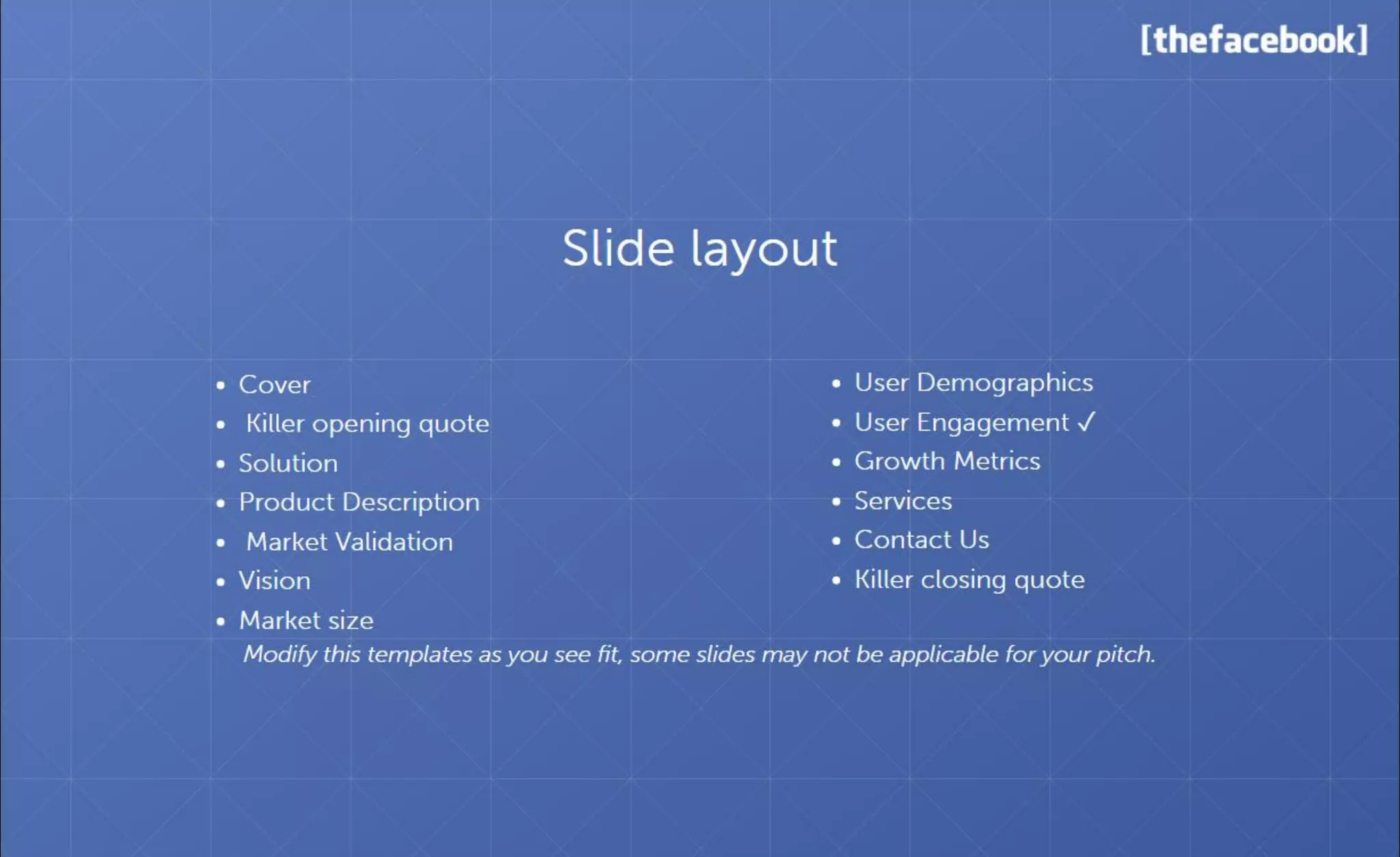
2. Slide layout
A template table of contents: cover, killer opening quote, solution, product description, market validation, vision, market size, user demographics, user engagement, growth metrics, services, contact us, killer closing quote. A note: "Modify this templates as you see fit, some slides may not be applicable for your pitch."
This slide confirms it is a template built from the kit. As a checklist it is useful, but it has no team, business model, financials or ask: a media kit never needed them.
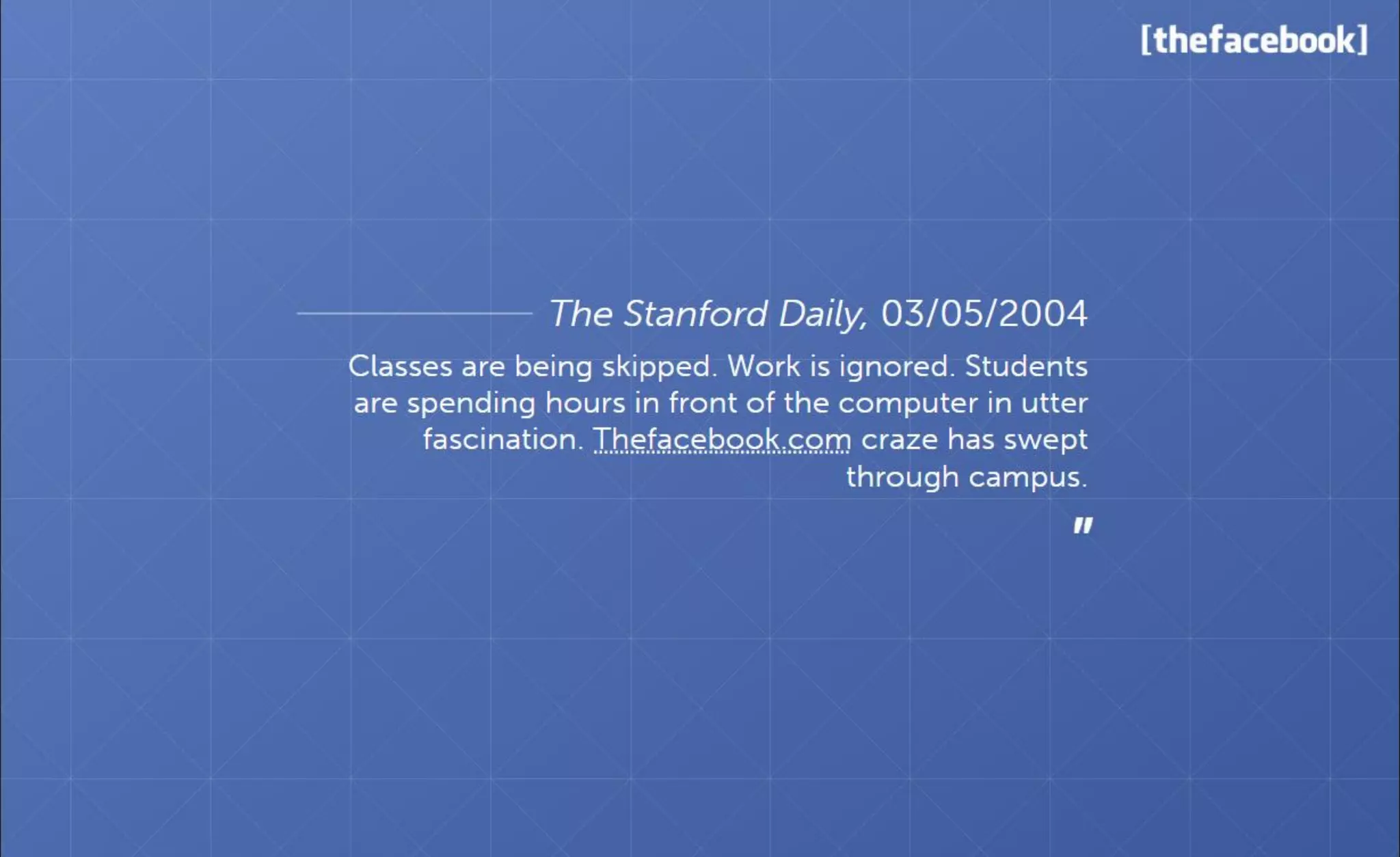
3. The Stanford Daily quote
The Stanford Daily, March 5, 2004: "Classes are being skipped. Work is ignored. Students are spending hours in front of the computer in utter fascination. Thefacebook.com craze has swept through campus."
Opening with a third party describing obsessive use proves engagement before a single number appears.
4. What is thefacebook.com?
An expanding online directory that connects students, alumni, faculty and staff through social networks at colleges and universities, with connections based on friendship, courses and social networks within and across schools, and a built-in messaging system.
One paragraph defines the product in its users' words: directory, friends, courses. No jargon, no vision statement.
5. User Profile
Each user keeps a profile with contact information; personal information (relationship status, political views, clubs, jobs, favourite music, books, movies and a quote); course information, from a built-in database of school courses that builds the user's class schedule automatically; and a picture. A screenshot of a profile sits beside the list.
A feature list next to a real screenshot is enough to explain a product. The class schedule feature shows how campus-specific the product was.
6. Automatic profile data
The site automatically adds to each profile links to school news articles that mention the user, the user's last AIM away message, and the last place the user logged in from, using a built-in database of dormitories and halls.
Profiles fill themselves from data the site already had. Today the same slide would also have to answer privacy questions.
7. Social Networking
Users browse their own school's network three ways: Social Net (ten random people from the school), Course Rosters (everyone enrolled in a course) and an Advanced Search Engine (search on every profile field). Users can add friends, pending verification by the other person, and each profile shows a map of the user's friend network and how the viewer is connected (friends, friends of friends).
Three concrete ways to discover people, each tied to campus life. Showing how users find each other matters more than listing features.
8. Intra-School Networking
Users can also browse the social networks of other schools through global search, and add a friend list for each school in the network. (The heading repeats "Intra-School", though the slide covers other schools.)
The cross-school network is what made each new campus more valuable to every existing user, the network effect behind the expansion slides.
9. Our Schools: The Expansion
Thefacebook.com launched on February 4, 2004 at Harvard University. As of April 10, 2004, the expansion had added the member schools on the next two slides.
A dated starting point turns the next two tables into a growth story.
10. Ivy League
Launch dates: Harvard February 4, Columbia February 24, Yale March 1, Dartmouth and Cornell March 7, Penn March 14, Brown and Princeton April 4, 2004.
All 8 Ivy League schools in two months, shown as a table of dates. Growth as a timeline is easy to read and hard to argue with.
11. Other Schools
Stanford February 26, MIT March 14, NYU and Boston University March 21, UC Berkeley April 4, Duke, Georgetown and Virginia April 11, and Tufts, Boston College, Northeastern and Illinois April 19, 2004.
20 schools in about ten weeks across the two tables. Note the April 19 dates fall after the "as of April 10" line: details like that get noticed.
12. The Expansion Plan
The mission is to expand to most schools in the United States. By September 1, 2004, the network will have more than 200 member schools.
A dated, measurable goal. "200 schools by September 1" is a promise an investor can track.
13. Our audience: The College Addiction
There are 15 million college students in the US with estimated purchasing power over $85 billion: $21B on restaurants and food, $9B on automobiles, $5B on clothes, $4B on phones and $46B on other amenities. College students are also active job seekers.
The market is sized the way the buyer thinks. An advertiser cares about student spending, not user counts, and the parts add up to the $85B total.
14. User Base Demographics: schools
Total students: 70,000, based on March 2004 statistics. Ivy League 55%, other schools 45%.
One number up front, then the split. Repeating the total on every demographics slide keeps the reader anchored.
15. User Base Demographics: roles
Of the 70,000: students 87%, alumni 11%, faculty and staff 2%.
For advertisers this confirms the audience is almost entirely students, which is exactly what they are buying.
16. User Base Demographics: gender and age
Men 48%, women 52%, and 92% aged 18 to 24.
A tight, valuable demographic in three numbers.
17. Site Usage
Daily unique users: 65%. Monthly unique users: 95%. Daily traffic: 3 million pageviews. Based on March 2004 statistics, with 70,000 total students.
The strongest slide in the deck: 65% of all users on the site every day. Today that ratio is the first engagement number investors ask for.
18. Site Usage: pageviews
Monthly traffic: 90 million pageviews, based on March 2004 statistics.
For an ad business, pageviews are inventory, so this number is the size of what the company can sell.
19. The Daily Pennsylvanian quote
The Daily Pennsylvanian, March 25, 2004: "I have a new addiction. It is powerful. It is disturbing. It is thefacebook.com"
A second campus paper, a second school, the same story. Repeated third-party proof from different places reads as a pattern.
20. User Growth Rate
The growth rate of total users is increasing, with 10,000 new members in the first week of April 2004. The share of daily unique users has slightly increased, and monthly pageviews have grown in step with the user base.
Growth described in sentences instead of a chart. Plot users over time; a line going up does the work of this whole slide.
21. Our services: Online Marketing Services
A section divider: "Our services - Online Marketing Services".
From here on the kit sells ads, which is where it parts ways with an investor deck.
22. Advertisement
Companies can reach college students, alumni, faculty and staff at the library, at work, at home or in dorm rooms, using horizontal and vertical banners, links and more contextual ad placements, with help choosing the most effective placements for the campaign.
The business model in one slide: sell attention to companies that want students.
23. Targeted Advertisement
Ads can be targeted on any combination of college, degree type, concentration, courses taken, class year, house or dormitory, age, gender, sexual orientation, home city, state and zip, relationship and dating interests, personal interests, clubs and jobs, political views, number of friends within and across schools, and site usage.
Targeting by profile data is the idea the company's ad business was built on, and it is already here in the spring of 2004.
24. Rates
Banner rates vary by scope, duration and targeting, in sizes 468x60, 120x240, 120x90 and 125x125. Link rates vary by targeting. Advertisers are asked to get in touch for a rate card, with their duration, targeting and budget.
No prices on the slide. A media kit can leave that to a call; an investor deck cannot leave out revenue.
25. Contact Us
Interested companies are asked to email: "We will help expose your product, service or recruitment effort to thousands of college students, alumni, faculty and staff throughout the country." The contact is Eduardo Saverin, CFO, Thefacebook.com, Cambridge, MA.
The call to action is aimed at advertisers, the clearest sign of who this deck was for.
26. The Harvard Independent quote
The Harvard Independent, March 4, 2004: "The wonderful thing about The Facebook is its ability to connect so many people through so many different avenues, including courses, interests, houses, politics, concentration, and favourite movies."
Closing on a quote that restates the product in a user's words leaves the reader with the value, not the rate card.
What founders can copy from the Facebook deck
- Lead with engagement, not size: 65% of users on the site every day said more than the 70,000 total.
- Size the market the way your buyer thinks: for advertisers, $85B of student spending, not the number of students.
- Show growth as dated launches: 20 schools with their launch dates in about ten weeks.
- Let third parties describe the obsession: three campus newspapers, three schools.
- Set a dated goal an investor can track: 200+ schools by September 1, 2004.
What would not pass with investors today
- It was built to sell ads, not to raise: no team slide, no financials, no use of funds and no ask.
- Growth is told in a sentence ("increasing") instead of a chart of users over time.
- The business model is banner ads with no prices, so an investor cannot size revenue from it.
Raise like Facebook
Frequently Asked Questions
Is this the pitch deck Facebook used to raise money?
No. It is the Spring 2004 media kit thefacebook.com used to sell ads, redesigned as a pitch deck template. It sells banner ads and targeting to companies and ends with ad sizes, rates and a contact for online marketing services. It has no team, financials or investment ask.
What is in the Facebook pitch deck?
26 slides: the cover, a template layout slide, three campus newspaper quotes, the product (profiles, automatic profile data, networking within and across schools), the expansion (launch dates for 20 schools and a goal of 200+ by September 1, 2004), the audience and its spending, user demographics, site usage, growth, and the advertising offer with targeting options, rates and a contact.
How many users did Facebook have in the 2004 deck?
70,000 students, based on March 2004 statistics, with 65% visiting daily and 95% monthly, 3 million pageviews a day and 90 million a month. It also reports 10,000 new members in the first week of April 2004.
What can founders learn from the Facebook media kit?
Lead with engagement (65% of users daily), size the market the way your buyer thinks ($85B of student spending for advertisers), and show growth as a dated list of launches.
How many slides is the Facebook pitch deck?
The Facebook deck is 26 slides. Sign up free to view every one of them on this page.
Can I download the Facebook pitch deck?
There is no download, but you can study every slide free after a quick signup, right here on the page.
How do I find investors who fund Social startups?
Round Funded matches you to active investors by industry and stage and helps you send your pitch. Sign up free to start.