
Airbnb Pitch Deck
The Airbnb pitch deck is the 14-slide seed deck the founders used in 2008, when the company was still called AirBed&Breakfast. Its one-line pitch was "Book rooms with locals, rather than hotels", and its last slide asked for a $500K angel round to reach 80,000 bookings in 12 months. Below is every slide in order: what it says, and what founders can still copy from it.
11 more slides
Sign up free to view the full deck here and study more real decks that raised.
- Industry
- Marketplaces
- Business model
- C2C
- Round
- Seed
- Year
- 2008
- Raised
- $600K
- Founded
- 2008
- Slides
- 14
How this deck compares
Airbnb closed its Seed round with a 14-slide deck. That is 2 slides longer than the median Seed deck in this library, which runs 12 slides across 134 decks that actually raised.
The round brought in $600K.
The company was founded in 2008, the same year this deck went out.
The Airbnb pitch deck, slide by slide
1. Welcome
The AirBed&Breakfast logo and one line: "Book rooms with locals, rather than hotels." The footer carries a San Francisco street address, a phone number and a founder's email.
Seven words explain the whole company, and they define it against something every investor already knows: hotels. If your one-liner needs a second sentence, it is not done yet.
2. Problem
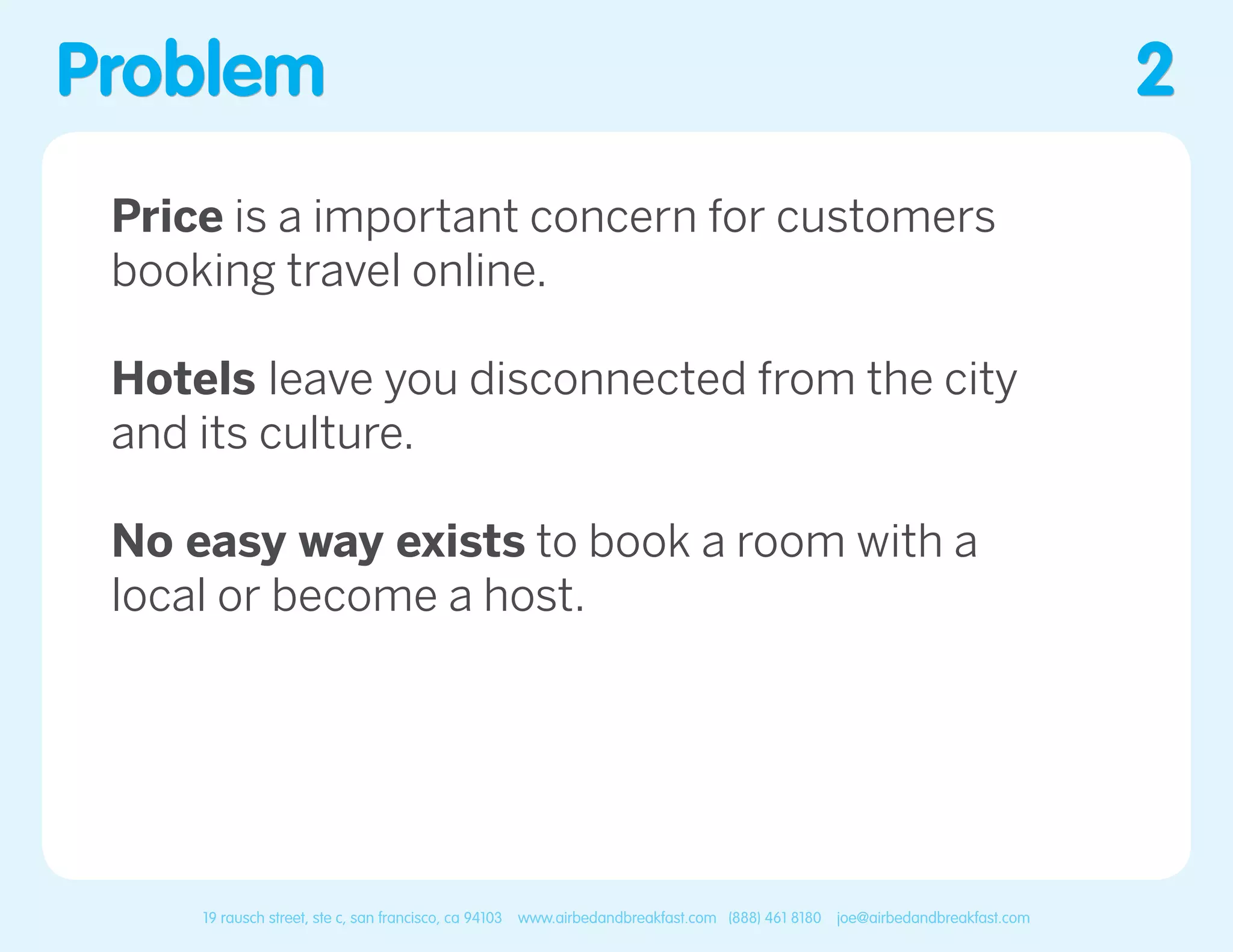
Three bolded problems, one line each: price is an important concern for customers booking travel online; hotels leave you disconnected from the city and its culture; no easy way exists to book a room with a local or become a host.
Each problem maps to one part of the solution on the next slide, and the third covers both sides of the marketplace, guests and hosts. There is no data on this slide. The numbers come two slides later.
3. Solution
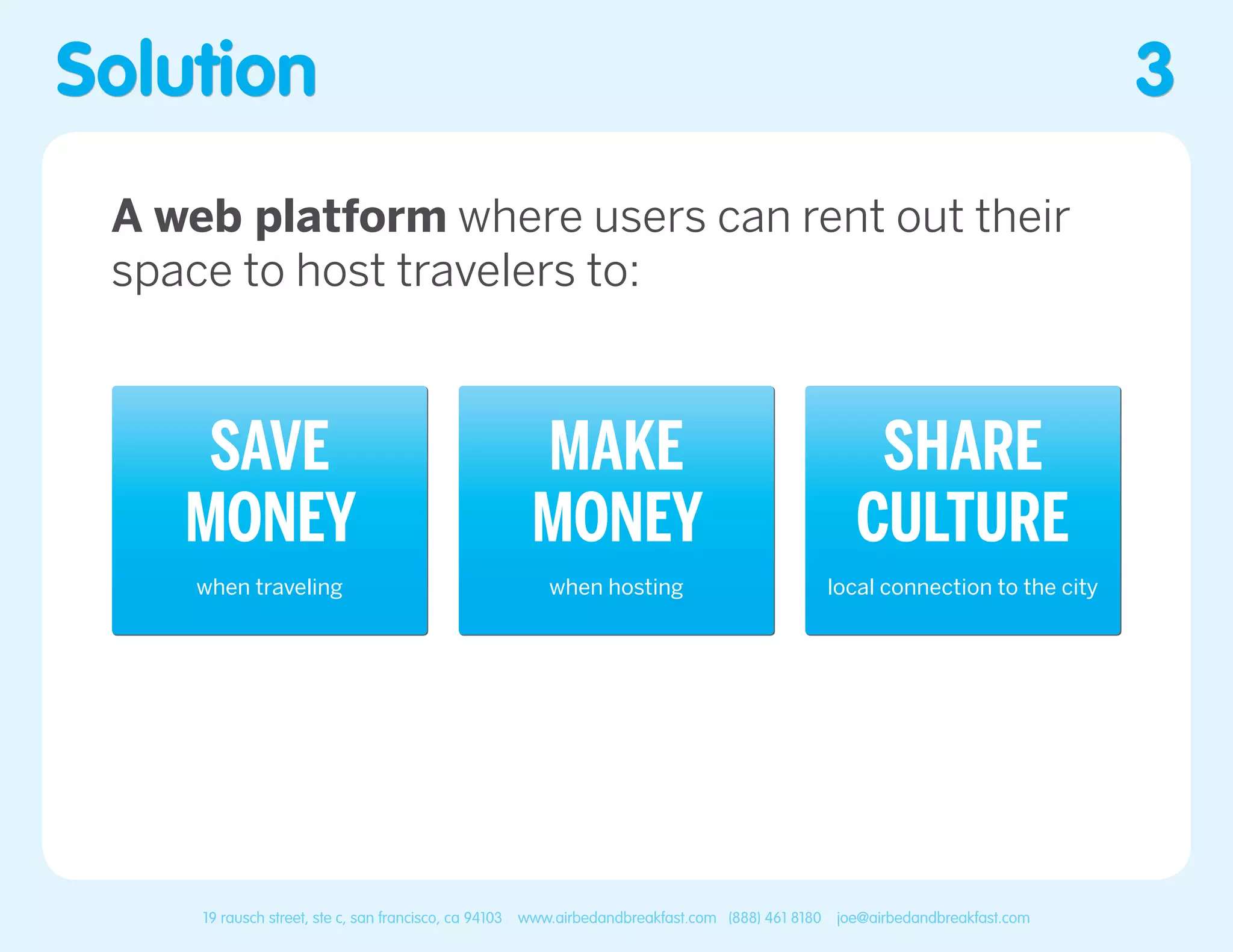
A web platform where users rent out their space to host travelers, framed as three outcomes: save money when traveling, make money when hosting, and share culture through a local connection to the city.
Save, make and share answer the three problems one for one. Writing the solution as an outcome for each side of a marketplace is still the cleanest way to pitch a two-sided product.
4. Market Validation
Two numbers from other companies: Couchsurfing's 660,000 total users, and 50,000 temporary housing listings per week on Craigslist in the US, counted over one week in July.
The slide to copy when you have no traction of your own. The deck shows no usage numbers for AirBed&Breakfast, so it borrows proof from two platforms where people already did the thing at scale. It even misspells Couchsurfing, and the point still lands.
5. Market Size
Three circles: 2 billion+ trips booked worldwide as the total available market, 560 million budget and online trips as the serviceable market (source: comScore), and 84 million trips, 15% of that, as the target share.
A clean TAM, SAM and share structure with a source under each number. The weak point is the 15% share, which is stated, not derived. Investors now expect a bottom-up build instead: the customers you can reach times what each one pays.
6. Product
A three-step flow across real screenshots of the site: search by city, review listings, book it. The listings on screen are rooms in Denver at $75 to $100 a night during the Democratic National Convention.
Screenshots of a working site beat mockups, and the three-step label lets an investor follow the product without a demo. Showing a live event in the listings also sets up the adoption slide.
7. Business Model
"We take a 10% commission on each transaction." Then the chain: 84 million trips, times a $25 average fee ($80 a night for 3 nights), equals $2.1 billion in revenue, projected by 2011.
One sentence of model, then the arithmetic that turns it into revenue: share, unit fee, revenue. One detail a careful investor will catch: the footnote cites a $70 average room price while the math uses $80.
8. Adoption Strategy
Three channels. Events: target one big event a month (Oktoberfest 6M, Cebit 700,000, Summerfest 1M, Eurocup 3M+, Mardi Gras 800,000) with a listing widget. Partnerships with cheap and alternative travel sites: GoLoco, Kayak, Orbitz. Craigslist: a dual posting feature.
A distribution plan, not a marketing budget. Every channel is specific enough to test in a week, and the Craigslist dual posting is the tactic that later became the best-known story of Airbnb's early growth.
9. Competition
A 2x2 chart: affordable versus expensive, offline versus online transactions. Couchsurfing, Craigslist and BedandBreakfast.com sit on the affordable offline side, Rentobi and VRBO on the expensive offline side, RentaHome, Orbitz and Hotels.com on the expensive online side. AirBed&Breakfast shares the affordable online corner with Hostels.com only.
Pick the two axes where you win and the chart does the arguing. Grouping Craigslist and Couchsurfing as offline transactions is what opens up the empty corner.
10. Competitive Advantages
Six tiles: first to market for a transaction-based temporary housing site; host incentive (hosts make money, unlike on Couchsurfing); list once (versus reposting daily on Craigslist); ease of use (search by price, location and dates); profiles (browse hosts and book in 3 clicks); design and brand (launch at the historic DNC).
Each advantage is phrased against a competitor named on the slide before. "Hosts post one time with us vs. daily on Craigslist" convinces more than any general claim about a better experience.
11. Team
Joe Gebbia, user interface and PR: RISD graduate in graphic and industrial design, holds a patent for his product CritBuns. Brian Chesky, business development and brand: RISD graduate in industrial design, ran his own design consultancy. Nathan Blecharczyk, developer: Harvard computer science, built Facebook apps with 75,000 users, worked at Microsoft. Advisor: Michael Seibel, CEO and co-founder of Justin.tv.
Two designers and an engineer, each with one concrete proof point: a patent, a consultancy, an app with 75,000 users. A specific achievement reads stronger than a title.
12. Press
Four quotes: Webware ("a fun approach to couch surfing"), Josh Spear ("Think of it as Craigslist meets Hotels.com, but a lot less creepy"), Mashable ("a cool alternative to a boring evening in a hotel room") and Springwise (the fee-based service "could help alleviate concerns about quality of accommodations").
Early press is borrowed credibility. The Josh Spear line positions the company in one sentence, which is why it is the quote people remember from this deck.
13. User Testimonials
Four video stills of early users from Washington DC, Atlanta, Austin and Ontario, one quote each, including a host: "A complete success. It is easy to use and it made me money."
Quotes from guests and from a host show the marketplace working on both sides, which no metric on the deck could show yet.
14. Financial
"We are looking for 12 months financing to reach 80,000 transactions on AirBed&Breakfast." The ask: a $500K angel round. The target: 80,000 trips at a $25 average fee, or $2M in revenue over 12 months.
The ask names the amount, the runway and the milestone in one sentence, and it reuses the $25 fee from the business model slide, so the numbers hold together across the deck.
What founders can copy from the Airbnb deck
- Borrow traction when you have none: Couchsurfing and Craigslist numbers proved the demand before AirBed&Breakfast had its own.
- Carry one unit number through the whole deck: the $25 average fee drives both the $2.1B projection and the $2M 12-month target.
- Ask in milestones: the amount, the runway and the proof point the money buys.
- Write the solution as an outcome for each side of the marketplace: save money, make money, share culture.
- Make the distribution plan specific enough to test next week: named events, named partners, one growth feature.
What would not pass with investors today
- No usage numbers of its own. A seed investor today expects some traction, even early bookings or a waitlist.
- Top-down market sizing. The 15% share of 560 million trips is stated, not built from customers the team could actually reach.
- A $2.1B revenue projection three years out, with no cost side and no path between the $2M target and that number.
Raise like Airbnb
Frequently Asked Questions
What is the Airbnb pitch deck?
It is the 14-slide seed deck Airbnb's founders used in 2008, when the company was still called AirBed&Breakfast. It pitched "Book rooms with locals, rather than hotels" and asked angel investors for $500K.
What slides are in the Airbnb pitch deck?
14 slides, in this order: Welcome (the cover), Problem, Solution, Market Validation, Market Size, Product, Business Model, Adoption Strategy, Competition, Competitive Advantages, Team, Press, User Testimonials and Financial.
How much was Airbnb asking for in its pitch deck?
$500K. The last slide asks for a $500K angel round to fund 12 months and reach 80,000 transactions, about $2M in revenue at a $25 average fee. The seed round Airbnb went on to close was $600K.
What can founders learn from the Airbnb pitch deck?
Three things hold up today: prove demand with other platforms' numbers when you have none of your own, carry one unit-economics number through every slide, and phrase the ask as amount, runway and milestone.
How many slides is the Airbnb pitch deck?
The Airbnb deck is 14 slides. Sign up free to view every one of them on this page.
What round and year is the Airbnb deck?
It is the Seed deck Airbnb used in 2008.
How much did Airbnb raise?
Airbnb raised $600K around this deck.
Can I download the Airbnb pitch deck?
There is no download, but you can study every slide free after a quick signup, right here on the page.
How do I find investors who fund Marketplaces startups?
Round Funded matches you to active investors by industry and stage and helps you send your pitch. Sign up free to start.